Pure Detailing · San Diego & Southern California
Measured correction. Paint you can see into.
The right correction removes only what the paint can safely give. I measure first, test the approach and refine the finish without chasing defects at any cost.
Refining the surface
What correction means
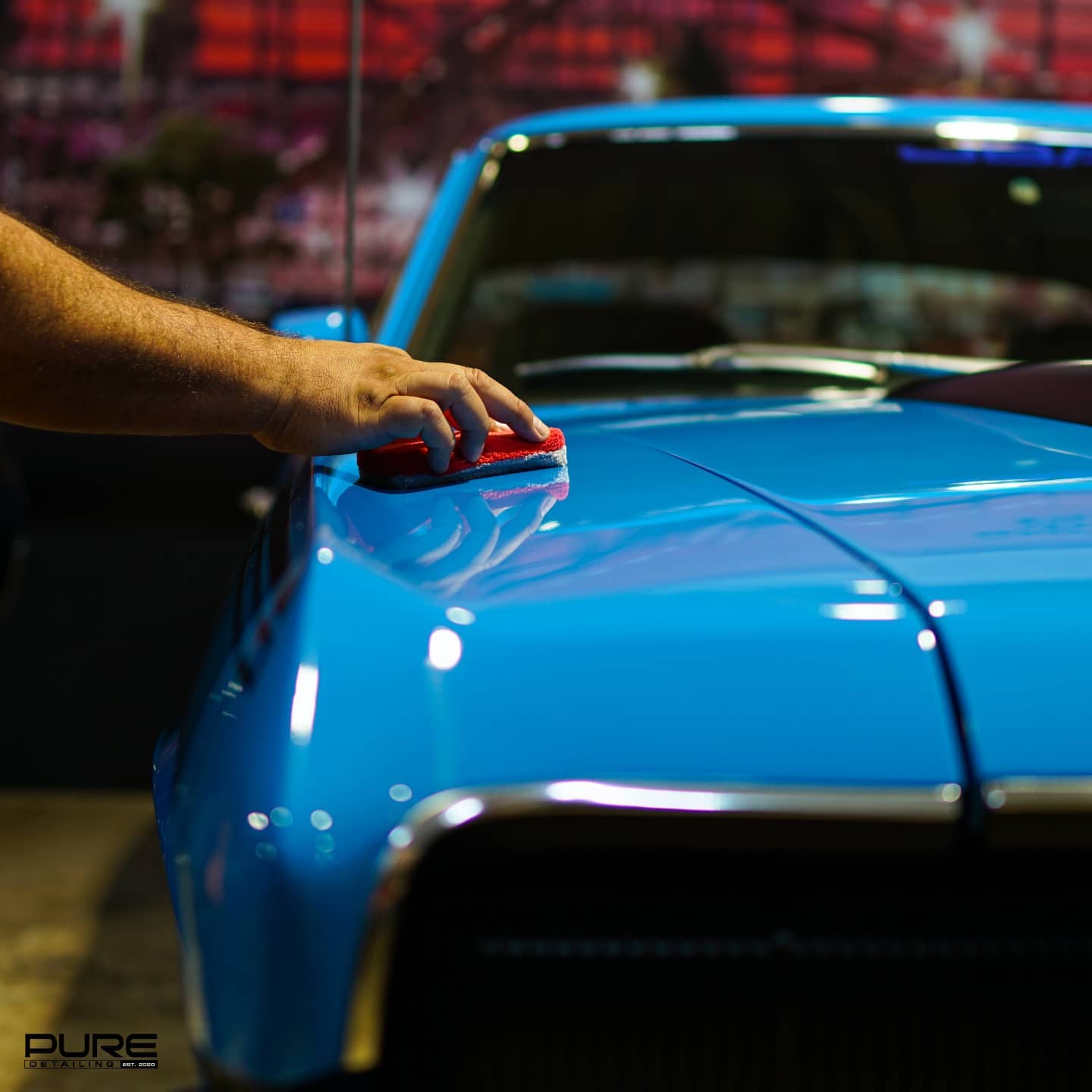
Machine polishing removes a thin, measured layer of paint to level swirls, holograms, light scratches and oxidation where the finish permits it. It is a change to the surface, not a temporary cover-up.
The aim is clarity within the limits of the paint. Some defects remain because preserving material matters more than removing every mark.
Clear coat is finite
Measure first. Then polish.
Paint-depth gauge readings help identify variations across the car. A reading is part of the assessment, not a guarantee of how much clear coat remains; some materials and paint systems limit what a gauge can tell us.
A test spot establishes the least aggressive useful approach. I remove only what is necessary and stop where the condition calls for restraint.
Enhancement or multi-stage correction?
Scope and timing depend on paint condition, size and access. Correction can take multiple days; the schedule is confirmed at evaluation. Quoted after a paint evaluation.
01
One-step enhancement
A single polishing stage improves gloss and reduces lighter defects. It suits a considered improvement rather than the pursuit of every deeper mark, with less work and time than a multi-stage plan.
02
Multi-stage correction
Separate correction and refining stages address more substantial defects and finish the surface carefully. More preparation and polishing time are needed; the achievable outcome is agreed after testing.
Originality has value
Single-stage paint & original lacquer
Single-stage paint and clearcoat are handled differently. On classics, I consider the finish's history, stability and the sheen appropriate to its era before polishing.
Original lacquer deserves restraint. Over-polishing can change its character, remove irreplaceable material and cost points at a concours. Conservation cleaning may be the correct choice instead of correction.
What correction cannot fix
01
Deep scratches
Scratches through clear coat cannot be safely polished back into intact paint. Some need a paint shop rather than more correction.
02
Stone chips
Missing paint cannot be restored with polishing. Touch-up or refinishing may be appropriate, depending on the car and your goals.
03
Failing finishes
Peeling clear coat, unstable paint and other finish failures need assessment beyond polishing. I will not chase gloss through compromised material.
Before we begin
Your questions
How long does it take?
It depends on the car, paint condition and agreed correction scope. A one-step enhancement requires less work than multi-stage correction, which may take multiple days. Timing is confirmed at the evaluation.
Can all scratches be removed?
No. Deep scratches, especially those through clear coat, cannot be safely corrected with polishing. Some marks remain to preserve the paint; others may need touch-up or a paint shop.
Is it safe for my paint?
The plan starts with assessment, paint-depth readings where suitable and a test spot. Polishing removes material, so there is no universal safety promise. If the paint is too fragile or limited, I recommend restraint or conservation cleaning instead.
Should I coat after?
A coating can help maintain a prepared finish on modern cars and driven classics. For restored concours cars, event and marque-club rules are checked first. Preservation originals receive conservation cleaning instead of coatings.
A considered combination
Related services
Ceramic coating
A protective coating for long-term gloss and easier washing, applied after decontamination and appropriate paint correction.
Explore servicePaint protection film
Clear protective film that helps shield painted surfaces from rock chips and road wear.
Explore serviceConcours & show preparation
Judging-aware preparation for classic, vintage and exotic cars, with originality guiding every decision.
Explore service
Start with the paint
A considered plan.
A finish worth caring for.
Tell me about your car, how you use it and what you want to achieve. The right work starts with an evaluation.
Book a paint evaluation